
Student Experience of Assessment
This video captures student perspectices on assessment

This video captures student perspectices on assessment

The information in this guide was submitted directly by interested vendors through a request
for information (RFI) that was issued internationally by the National Forum and HEAnet through
eTenders, the Irish Government’s tendering platform (Reference number: HEAnet_DESSI_
LearningAnalytics18). RFIs are standard business processes, through which suppliers and vendors
are asked to provide information on their products’ capabilities.
Individual vendors were not targeted. Rather, a general request was extended through eTenders,
inviting responses from self-selecting vendors that met a range of criteria, most notably that they
had already worked with HEIs in Europe to provide platforms that enabled analysis of data relating
to student engagement and success.
Vendors were asked to respond to a standardised set of questions relating to:
— User functionality
— Service agreements
— Cost
— Infrastructural and technical specification
— Compatibility with platforms currently in use in Irish HEIs
In total, nine responses were received, all of which are included in this guide. The responses have
not been altered or edited and are presented in the exact format in which they were submitted
directly by the vendors themselves.

This study was conceived as part of a broader effort on the part of the Institute to understand with greater clarity the profile of the student body and specifically to identify factors that may negatively impact on student retention and progression. The institution also sought to build a more robust evidence base on which to plan proactive initiatives designed to address retention and progression issues at institutional, department, course and module level. In particular, they recognised the need for a more evidence-based understanding of the retention and progression challenges at module and programme level in order to inform more effective and targeted deployment of resources by faculty and by central services at the earliest possible stage in the programme lifecycle.
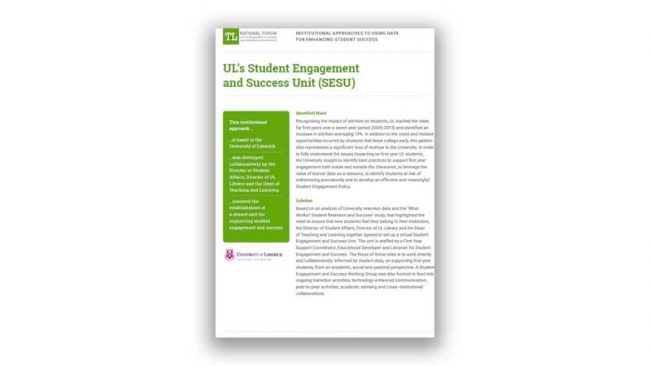
Recognising the impact of attrition on students, UL tracked the rates for first years over a seven-year period (2005-2013) and identified an increase in attrition averaging 13%. In addition to the costs and missed opportunities incurred by students that leave college early, this pattern also represented a significant loss of revenue to the University. In order to fully understand the issues impacting on first year UL students,
the University sought to identify best practices to support first year engagement both inside and outside the classroom, to leverage the value of learner data as a resource, to identify students at risk of withdrawing prematurely and to develop an effective and meaningful Student Engagement Policy.
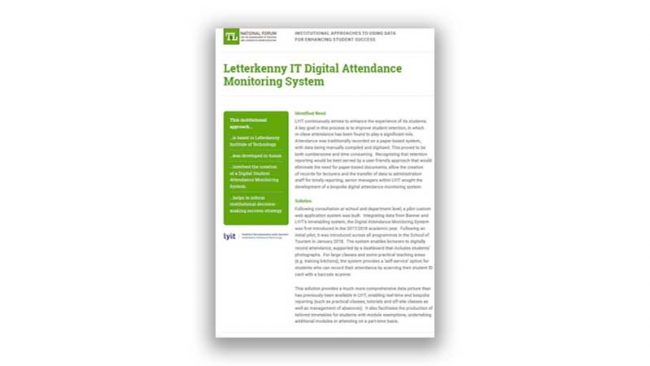
LYIT continuously strives to enhance the experience of its students. A key goal in this process is to improve student retention, in which in-class attendance has been found to play a significant role. Attendance was traditionally recorded on a paper-based system, with data being manually compiled and digitised. This proved to be both cumbersome and time consuming. Recognising that retention reporting would be best served by a user-friendly approach that would eliminate the need for paper-based documents, allow the creation
of records for lecturers and the transfer of data to administration staff for timely reporting, senior managers within LYIT sought the development of a bespoke digital attendance monitoring system.

IT Blanchardstown has long recognised the value of data for enabling an evidence-based approach to decision-making. Given an increasing interest in maximising the power of that data, but cognisant of the importance of using it in an ethical and sustainable way, the need was established for an institute-wide policy and strategy that would set boundaries and guidelines for operationalising learning analytics initiatives. It was a necessary first step in ensuring appropriate use of student data for learning analytics, and to collaboratively define
a roadmap for next steps in implementing data enabled student success initiatives.
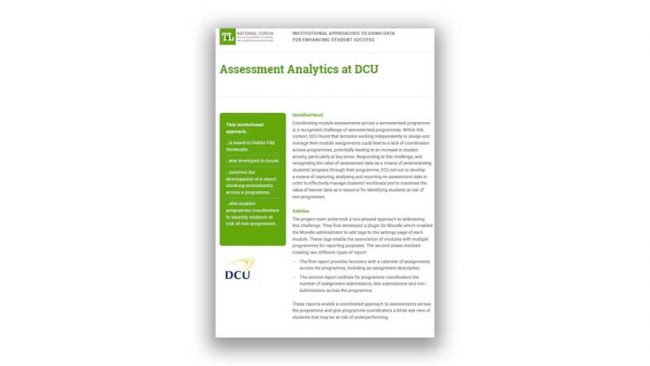
Coordinating module assessments across a semesterised programme is a recognised challenge of semesterised programmes. Within this context, DCU found that lecturers working independently to design and manage their module assignments could lead to a lack of coordination across programmes, potentially leading to an increase in student anxiety, particularly at key times. Responding to this challenge, and recognising the value of assessment data as a means of understanding students’ progress through their programme, DCU set out to develop a means of capturing, analysing and reporting on assessment data in order to effectively manage students’ workloads and to maximise the value of learner data as a resource for identifying students at risk of non-progression.
Trends 2018 provides an institutional perspective on the developments in the European Higher Education Area. It continues the work started by Trends 2015 in examining how European higher education institutions change and adapt their learning and teaching approaches in response to changing demand, technological and societal developments, and in consideration of European and national level policies and reforms.
A key point is how the implementation of learning outcomes and student-centred learning, central reform goals of the Bologna Process and the EU Modernisation Agenda has contributed to the enhancement of learning and teaching, and how, in turn, this has impacted institutional strategies and structures that support learning and teaching
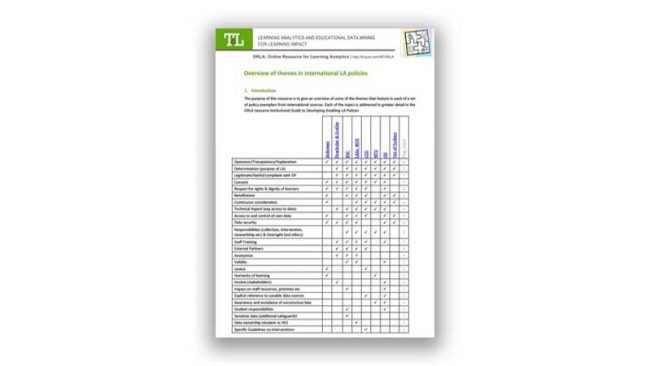
The purpose of this resource is to give an overview of some of the themes that feature in each of a set of policy exemplars from international sources. Each of the topics is addressed in greater detail in the ORLA resource Institutional Guide to Developing Enabling LA Policies
The fundamental role of Learning Analytics is to answer questions. These questions should provide actionable insights that institutions, teaching staff and students use to drive effective change. Identifying the initial question to be addressed is a key first step as it will dictate every other aspect of the institutional strategy.
This resource is intended to help institutions to review some questions they may wish to begin with as well as some of the data sources that may be used to provide answers. It is divided into questions designed to enable institutional insights, lecturer-facing insights and student-facing insights.
This resource should not be considered an exhaustive list, but rather a high-level guide to some of the popular applications of Learning Analytics. It should also be noted that the data recipes below are not the only means of answering the questions listed, they are merely suggested methods.
Institutions are also reminded that any use of personal data must be fully compliant with the conditions of the GDPR.

