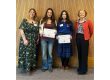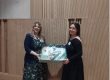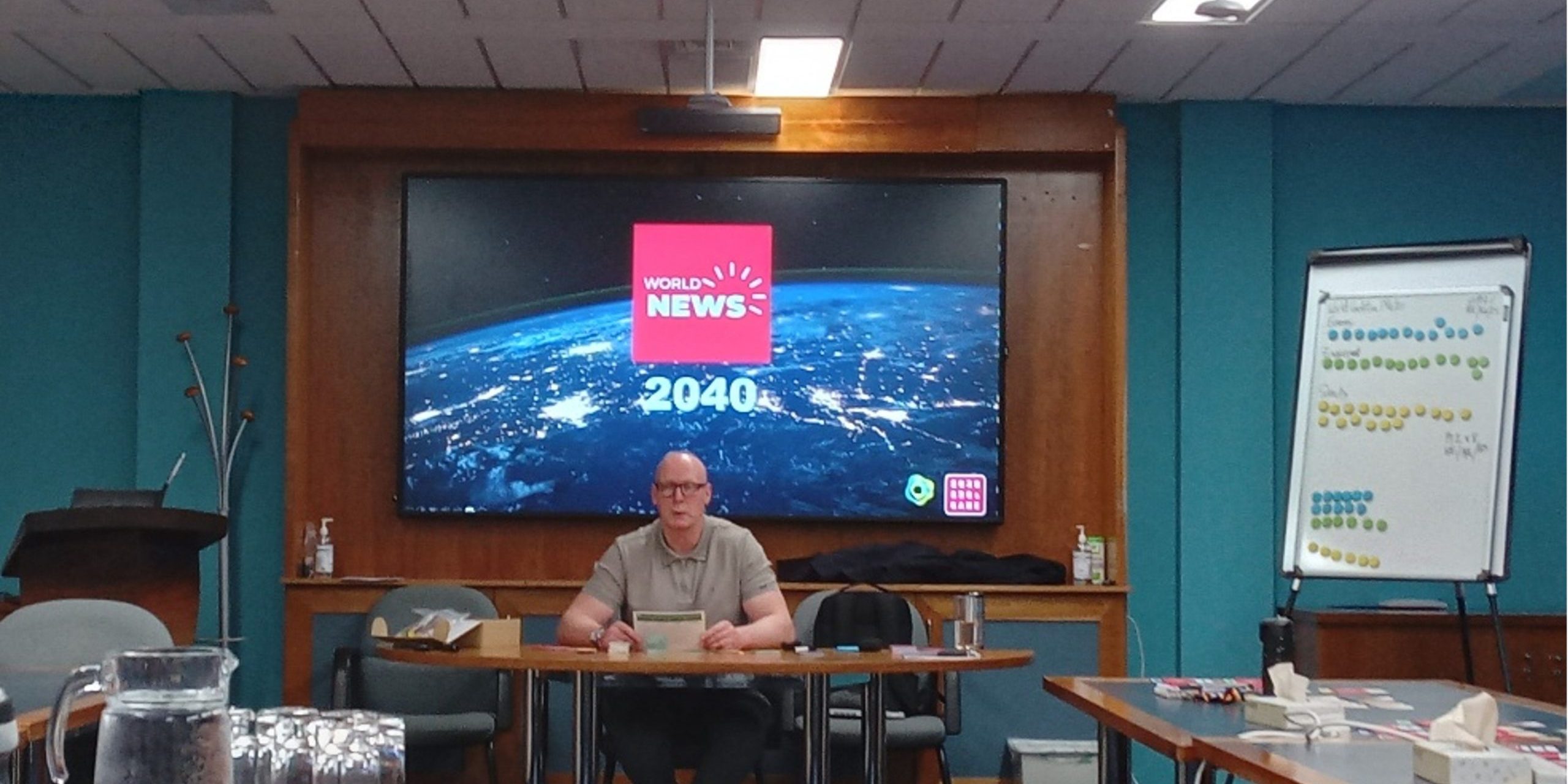
A Climate Action workshop was organised on 07 November 2025 by the HEA Green Team leader, Jack Gleeson.
The workshop was based on the 2030 SDGs game and was attended by members of the HEA Green Team and other staff members. It was facilitated by ATU academic, Dr. Mark Kelly, who is currently on secondment to the HEA as a national Policy Advisor on Education for Sustainable Development.
The 2030 SDGs game workshop is a card game that simulates taking the world into the future (2030 and then 2040). Players use “money” and “time” cards to achieve their goals by the end of the game. The goals are different, just as priorities are different for real world people: some want to become prosperous, others want to enjoy leisure, while others wish to achieve social justice or protect the environment. Choices made by the players have an impact on the world illustrated by the “World Condition Meter”, which is organised into three categories, “Economy”, “Environment” and “Society”.
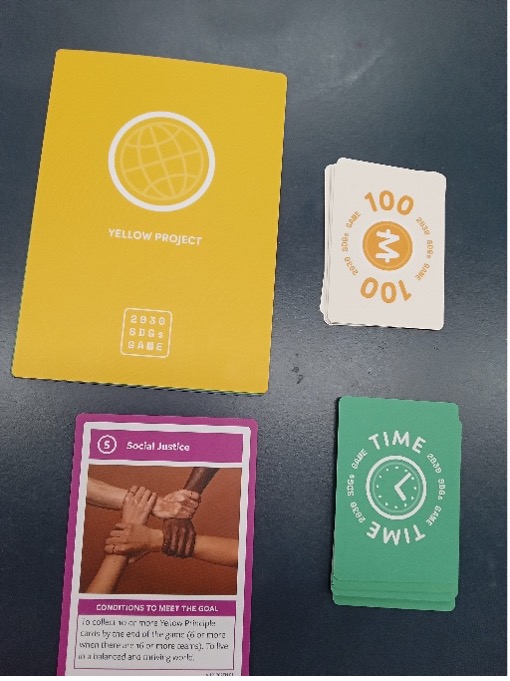
There were two fast-paced sessions during which the cards were played: the first one took the world into 2030 and the second one, into 2040. Each session was followed by a “news report” presented by Dr. Kelly, detailing the state of the world as shown by the World Condition Meter.
Our first session’s results were disastrous for society and the environment, while business (the “Economy” indicator) boomed. This made us realise that we need to start working together to both achieve our own aims and ensure that the environment and society thrive. As a result, by the end of the second session (in 2040), the World Condition Meter was balanced in all three categories, “Economy”, “Society” and “Environment”.
The importance of collaboration is emphasised in participants’ reflections on the event:
“This was a fun and engaging session that really made me stop and think about how our decisions, individually and collectively, can have an impact. The difference between the first and second session was notable in that everyone grouped together the second time around after seeing the negative impact of working in silos. Once everyone collaborated the future was far less bleak!” (Aoife Cooney, International)
“I found the 2030 SDG Game facilitated through the HEA Green Team an enjoyable and unique way to demonstrate the importance of working collaboratively to achieve progress in a sustainable way. The game itself reinforces the need to ensure that people and the planet are considered alongside profit. The game is a practical exercise in systems thinking and participants are challenged to understand the potential feedback loops which impact negatively or positively on society and the environment, not focusing solely on the economy.” (Ciara Melinn, Green Team member, Skills)
Dr. Kelly, who facilitated the game, remarked on the importance of the HEA’s leading role in supporting climate action and sustainability in the higher education sector:
“I hope the HEA Green Team and other staff members enjoyed participating in the workshop and it was great to see such enthusiasm and engagement during the workshop. The most powerful aspect of the game is the reflection element towards the end of the workshop, where participants reflect on the ‘condition of the world’ in 2030 and 2040 and each person’s role in creating these worlds.
This workshop builds on HEA staff undertaking Carbon Literacy training earlier in the year, which demonstrates a real commitment to engaging with the sustainability and climate action agenda. The HEA has a unique opportunity to demonstrate real leadership across the sector on climate action, sustainability, and the SDGs.”
For me personally, the game also emphasised the significance of time. The card sessions were fast-paced and during them a timer was ticking away on the screen. I think this was meant to show that we are quickly running out of time when it comes to climate action. We cannot afford to postpone taking action, or to do it slowly, when so much is at stake.
The significance of collaboration and immediate action is encapsulated in the name of the Japanese organisation that created the 2030 SDGs game, Imacocollabo. In Japanese, “ima” means “now” and “coco” means “here”; “collabo” refers both to collaboration and to experimentation (“labo”). Their message is “don’t expect someone, some day, to take effective action; instead, take action yourself, right here and right now. It does not matter if it is imperfect. Actually, imperfection leads to collaboration and creates the possibility of creating something new and unpredictable.”
Submitted by Dr. Dana Cocargeanu, Green Team member, International, Higher Education Authority