Led by the Centre for Academic Practice (CAP) at Trinity College Dublin, the GenAI Plan 2023-25 has produced significant results in three key areas: Resources, Professional Development and Research.
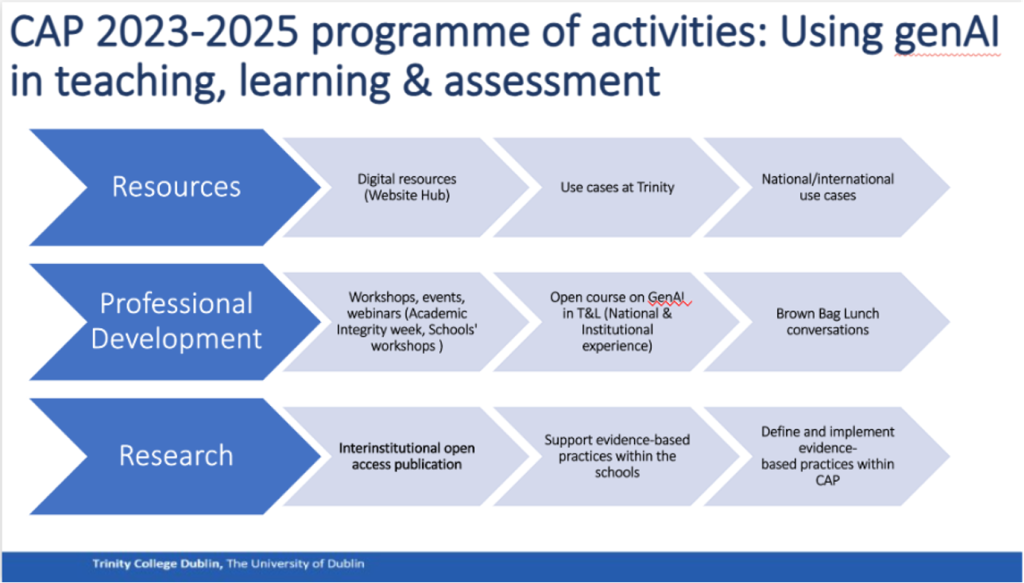
As part of the Resources strand, a dedicated GenAI hub was launched in September 2024. Designed to support T&L and assessment, the hub offers content at six levels and incorporates the College Statement on GenAI, which was formally approved following extensive consultation with faculty members. Additional content includes national and international frameworks, such as the PAIR and the AI Assessment Scale. Early adoption was encouraged through discipline-specific case studies. To keep up with the rapid development of GenAI, the hub is updated annually.
In the Professional Development strand, the open course Using GenAI in T&L: How to do it right?, developed in collaboration with DCU and UL, attracted over 300 participants nationwide. Due to capacity, only 80 people earned their badge. However, the open course has been integrated into the VLE of many universities in Ireland, achieving relevant results. In Trinity, it has also been successfully embedded in the SP Certificate for T&L, as well as being offered as a professional development activity in two formats: a self-study version, launched in 2025, which has already attracted over 380 participants, while the facilitator-led version, with two iterations (May and September), has had over 140 registrations. As part of the informal professional development, the Brown Bag Lunch series provides a welcoming and safe space for colleagues to share and reflect on how they use GenAI in their teaching, helping to build a vibrant exploratory community. Additionally, tailored workshops were delivered to the Schools of Linguistics and Pharmacy. Due to the growing interest in embedding GenAI in T&L, demand for individual consultancy has steadily increased.
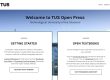
The Research strand saw the publication of a collaborative open-access book featuring 31 cases from seven Irish universities—completed in just ten months. The initiative has also earned international recognition through keynote invitations and partnerships with institutions in the EU Association, LAK25 Conference, and the USA.
Together, these achievements have positioned The Centre for Academic Practice in Trinity as a relevant contributor in the emerging field of GenAI for teaching, learning, and assessment—laying the groundwork for a new plan for 2025–2027.
Submitted by Dr. Ana Elena Schalk, Trinity College Dublin