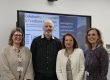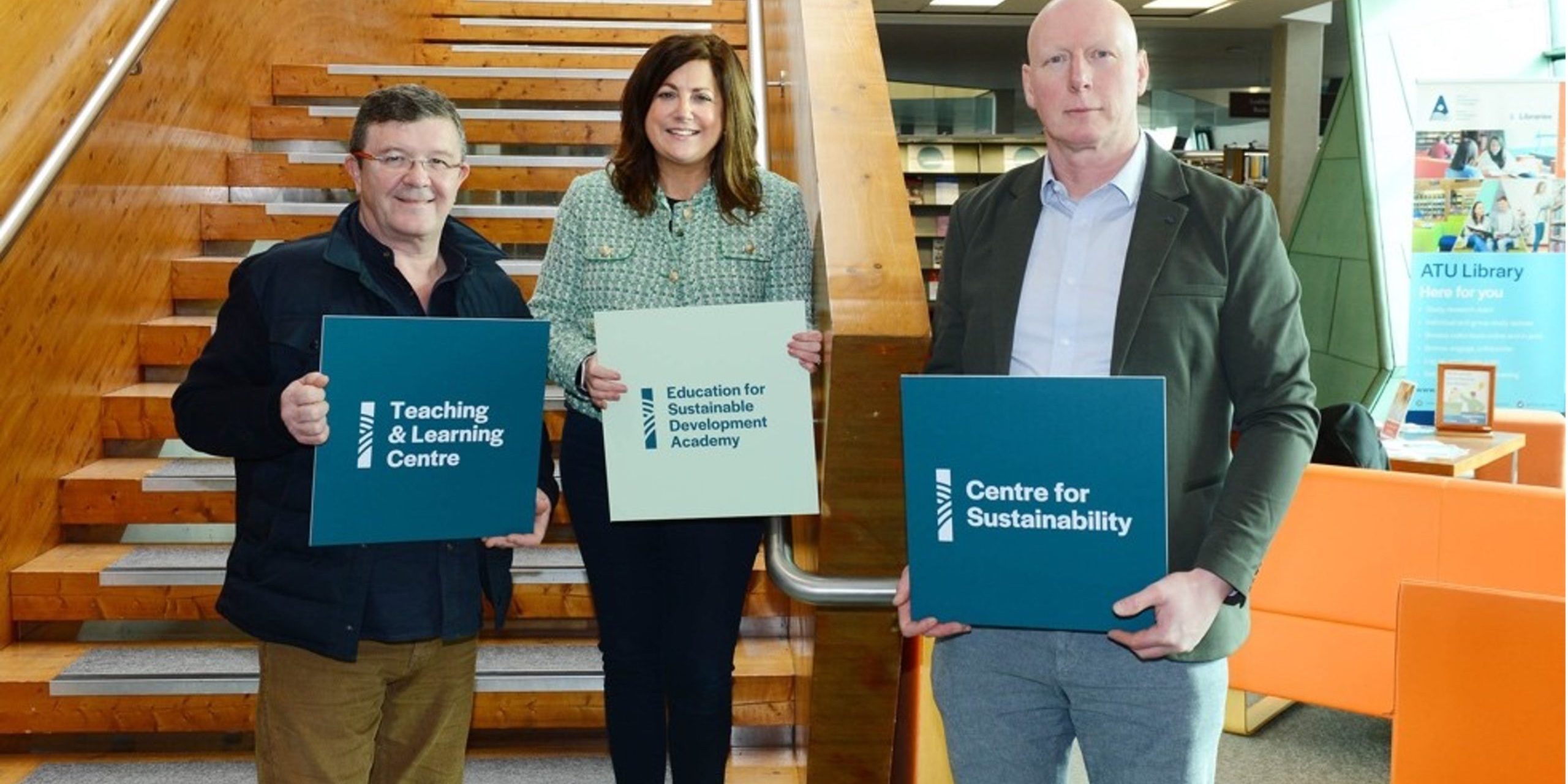
Left to right ATU team: Dr John Scahill, ESD Academic Developer T&L Centre, Dr Carina Ginty, Head of Teaching and Learning, Dr Mark Kelly, National Forum ESD Policy Advisor and Head of Centre for Sustainability.
The ATU Education for Sustainability (ESD) Academy, supported by SATLE funding from the HEA National Forum, is a collaboration between ATU Teaching and Learning Centre and the Centre for Sustainability. The ATU ESD Academy directly responds to the National Strategy of ESD to 2030, fostering a sustainable and circular living labs educational approach across each campus, demonstrating ESD leadership by embedding sustainability, the SDGs, climate action and justice holistically across the curriculum cultivating transformative learning AS sustainability. This is the first higher education ESD Academy to be established in Ireland.
The ATU ESD Academy is leading the way and embraces the ethics and practice of care in all its activities.
Collaborating across faculties, functional units, and research centres and groups to support a transition towards a ‘Climate Action University’, which will demonstrate a genuine and transparent commitment to sustainability, the SDGs, climate action and the circular economy through our own actions and values.
Community Collaborative Research by establishing ESD as a recognised research theme across teaching and learning, research, community and industry engagement, campus management and operations.
Promote and nurture community education initiatives focusing on capacity building and learning by doing through a genuine reciprocal relationship to learn FROM, WITH, and AS a community.
The ESD Academy will support ATU’s vision of ‘becoming an internationally renowned university that enhances the quality of life in our region and creates a sustainable future for all’ through the five guiding lights of enabling education, engaged research, a connected ecosystem, and sustainability for the future. The ESD Academy will demonstrate leadership through a whole-of-university approach to embed sustainability, the United Nations Sustainable Development Goals (SDGs) and climate action and justice at the very core of the curriculum in ATU.
The work of the academy will be framed by the 6Cs of Curriculum, Campus, Community, Collaborative Research, Culture, and Care. ‘ESD empowers learners with knowledge, skills, values, and attitudes to take informed decisions and make responsible actions for environmental integrity, economic viability, and a just society empowering people of all genders, for present and future generations, while respecting cultural diversity. ESD is a lifelong learning process and an integral part of quality education that enhances cognitive, social, and emotional and behavioural dimensions of learning. It is holistic and transformational and encompasses learning content and outcomes, pedagogy, and the learning environment itself.
Since launching the ATU ESD Academy in April, staff and students and wider networks across the higher education sector have started accessing a range of learning opportunities. A brochure of activities has been launched and this will frame the academy’s work plans in 2025. The initiatives are open to staff, students, community partners, industry, plus further and higher education institutes in Ireland.
Dr Mark Kelly, Head of ATU’s Centre for Sustainability, said: “I believe that this initiative demonstrates ATU’s commitment to embedding sustainability across the curriculum in a holistic way and provides an opportunity to build further capacity across our nine campuses, who are already doing some fantastic work. More importantly, it demonstrates to our students that ATU will play a leadership role in education for sustainability and the SDGs.”
Dr Carina Ginty, Head of Teaching and Learning at ATU, added: “At the heart of our ATU Curriculum Framework is Education for Sustainable Development (ESD) and ESD is crucial in learning, teaching and assessment, as it equips both students and staff with the knowledge, skills, values and attitudes necessary to contribute to a sustainable future.”
Learn more about the ATU ESD Academy and access the brochure of opportunities at https://www.atu.ie/about/teaching-and-learning/education-for-sustainability
Spotlight event in May:

On May 14th, at the ATU Galway City Campus hosted Dr. Alex Ryan for a full-day workshop focusing on the empowerment of student agency in ESD and quality enhancement in ESD. Dr. Ryan is a UK National Teaching Fellow and award-winning leader, known for driving education innovation and strategic change for sustainability in universities. Her expertise in Education for Sustainability focuses on curriculum transformation and institutional strategy, informed by leadership roles on major research collaborations and shaping sector guidance. Alex is passionate about empowering educators, students, and institutions to embed excellence in sustainability learning, equipping future generations and professionals to lead dynamic change.
Upcoming ATU ESD Academy activities in June include:
On May 29th and June 3rd (14.00-17.00 on both days)
ATU ESD Academy will host Climate Fresk Facilitator training for staff who would like to become a recognised ATU Climate Fresk Facilitators. Climate Fresk is an international workshop originating in France, which focuses on the fundamentals of climate change with the goal of developing participant’s understanding, awareness, and action. The Climate Fresk workshop can be used as part of student inductions, embedded into modules, and for engagement across communities. Learn more at https://climatefresk.org/world/
June 18th and 20th (10.00-13.00 on both days)
ATU ESD Academy will provide online Carbon Literacy training for staff who would like to embed the training into their modules or programmes. Each participant who completes the training can be certified as ‘Carbon Literate’ by the Carbon Literacy Project in the UK. Once certified, staff can also progress on a pathway to become accredited facilitators themselves with the support of the ATU ESD Academy. The online training is limited to 20 participants. See https://carbonliteracy.com/