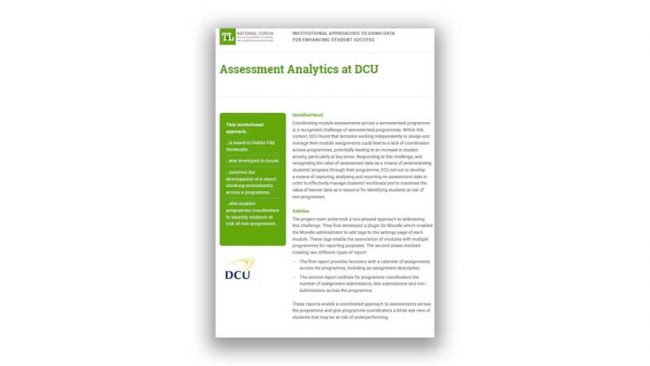
Assessment Analytics at DCU

Coordinating module assessments across a semesterised programme is a recognised challenge of semesterised programmes. Within this context, DCU found that lecturers working independently to design and manage their module assignments could lead to a lack of coordination across programmes, potentially leading to an increase in student anxiety, particularly at key times. Responding to this challenge, and recognising the value of assessment data as a means of understanding students’ progress through their programme, DCU set out to develop a means of capturing, analysing and reporting on assessment data in order to effectively manage students’ workloads and to maximise the value of learner data as a resource for identifying students at risk of non-progression.
Learning and Teaching in the European Higher Education Area

Trends 2018 provides an institutional perspective on the developments in the European Higher Education Area. It continues the work started by Trends 2015 in examining how European higher education institutions change and adapt their learning and teaching approaches in response to changing demand, technological and societal developments, and in consideration of European and national level policies and reforms.
A key point is how the implementation of learning outcomes and student-centred learning, central reform goals of the Bologna Process and the EU Modernisation Agenda has contributed to the enhancement of learning and teaching, and how, in turn, this has impacted institutional strategies and structures that support learning and teaching

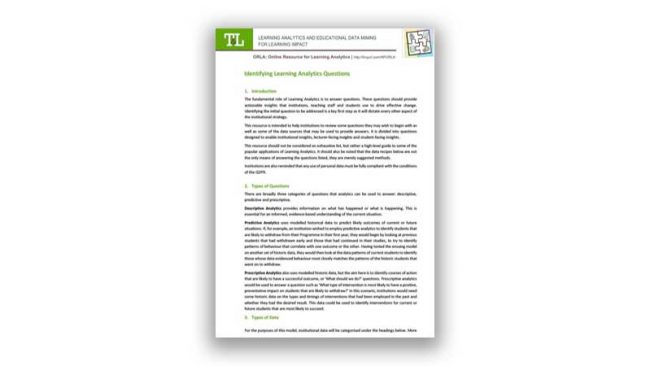
Identifying Learning Analytics Questions

The fundamental role of Learning Analytics is to answer questions. These questions should provide actionable insights that institutions, teaching staff and students use to drive effective change. Identifying the initial question to be addressed is a key first step as it will dictate every other aspect of the institutional strategy.

This resource is intended to help institutions to review some questions they may wish to begin with as well as some of the data sources that may be used to provide answers. It is divided into questions designed to enable institutional insights, lecturer-facing insights and student-facing insights.

This resource should not be considered an exhaustive list, but rather a high-level guide to some of the popular applications of Learning Analytics. It should also be noted that the data recipes below are not the only means of answering the questions listed, they are merely suggested methods.

Institutions are also reminded that any use of personal data must be fully compliant with the conditions of the GDPR.

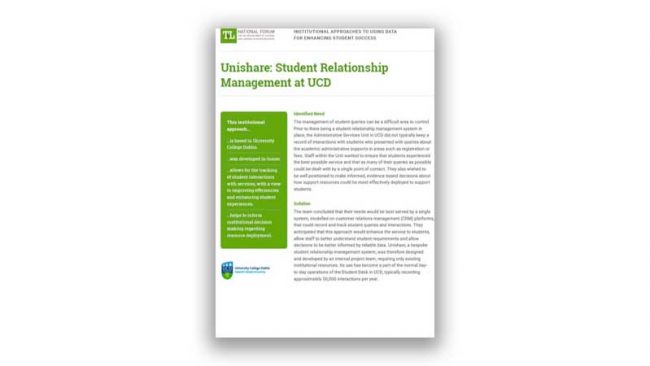
Unishare: Student Relationship Management at UCD

This institutional approach…
…is based in University College Dublin.
…was developed in-house.
…allows for the tracking of student interactions with services, with a view to improving efficiencies and enhancing student experiences.
…helps to inform institutional decision making regarding resource deployment.

CIT Faculty Dashboard

This institutional approach…
…is based in Cork Institute of Technology.
…was developed in-house.
…involved the creation of a dashboard which continuously gathers a range of data to inform institutional decision making.
…has been shown to have considerable strategic value.